




What a week of conversations with founders, investors, and operators taught me about where the startup world is heading.
What is Tech Week?
Tech Week (presented by a16z) isn’t a conference in the traditional sense but a decentralized week of events hosted by startups, funds, and companies across a city. There’s no central venue, no main stage or badge to pick up. Instead, there are demo days, dinners, panels, hackathons, rooftop meetups, and anyone can host.
In 2026, Tech Week reached Boston for the first time, followed by New York in June, San Francisco in early October, and Los Angeles from October 12 to 18. This year, I had the chance to attend the Los Angeles edition.
Who’s in the room?
Three groups make up most of the ecosystem: startups, investors, and operators.
These include the people building and working in tech, as well as the service providers supporting them — agencies, studios, legal, recruiting, and marketing.
Something I noticed this year was the growth of fractionals: experienced professionals, like a CMO, a head of product, or a finance lead, who work part-time for several companies instead of joining one full-time. It’s basically freelancing, but it sounds cooler. For startups, they offer senior expertise without the cost of a full-time hire. For the entire ecosystem, their growth shows a shift toward smaller teams that bring in specialists when they need them.
AI and agents, everywhere
Across industries like sales, health tech, finance, entertainment, ed tech, and sports, the common denominator wasn’t the problem being solved. The question stopped being ‘which problem are you solving?’ and became ‘how are you solving it with AI?’
In all honesty, after a decade of helping founders turn ideas into products, I used to love the variety of what came across our table — being able to run into new, unexpected ideas that solve problems in a surprising and innovative way. This week, I kept running into pitches that sounded very similar to one another.
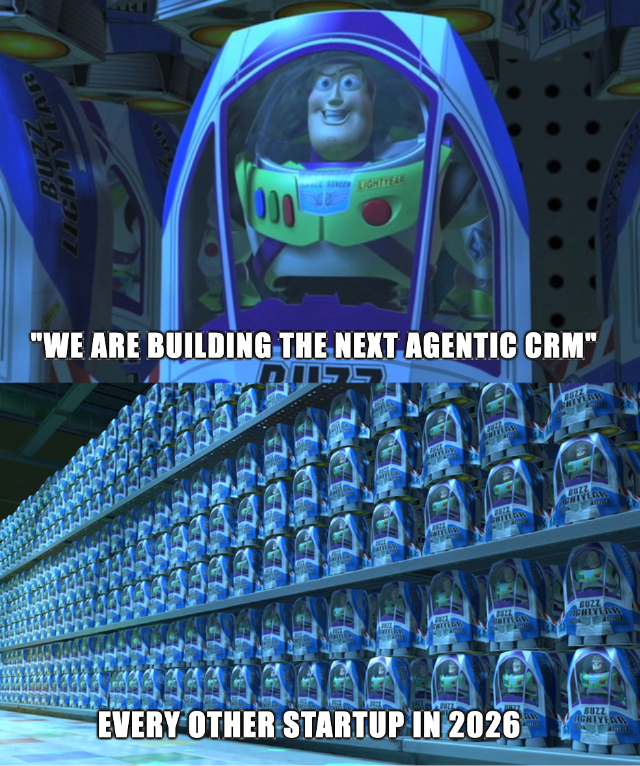
As founders bring similar solutions to life, speed becomes more important. There’s an urgency to be the one that can get a working product into users' hands, validate assumptions, learn from real feedback, and adapt before everyone else.
In that sense, the advantage is shifting from simply having the idea to knowing how to execute, learn, and move fast.
The founder mindset has changed
Building is no longer an obstacle. Technical founders are moving 10 times faster with AI. Non-technical founders no longer depend on a technical co-founder. Or at least not to get things started.
I met lawyers building products from their legal expertise, and professionals in film and entertainment doing the same. You don’t need years of learning to code. If you have an idea and the right AI tools, you can ship.
Building also became cheap. Many founders are thinking less about large funding rounds, and some are skipping VCs and private equity altogether (though many still aim for angel investors). Several startups I met launched less than two months ago and already have over 1,000 users.

What this means for startups
If building the foundation is no longer the hard part, distribution is. Getting the product in front of the right market and capturing attention before one of the other 30 startups solving the same problem reaches the same user base becomes the main challenge. This raises the value of marketing, sales, communications, and branding, and of the people who can articulate an idea in a crowded market.
The lifecycle is compressing too. A startup can now go from early stage to peak growth far faster than before. But ideas also die faster: they stall, hit technical debt, or fail to stay relevant in a market that moves at an extremely high speed.
The catch with building this way
Being part of Ananá Studio for the past 10 years has meant working closely with founders at different stages, from early ideas to growing products. I attended Tech Week to reconnect with that ecosystem and see where things are heading. I found there was more appetite to create than ever, but the building cycle has changed, and with it, the role of a professional team.
The process used to look like this: define → design → build → launch.
Today it looks more like: build → launch → organic reach → distribution → refine.
The entry point for specialized product teams now seems to come later in the growth cycle. Building this way comes with trade-offs:
- Products with unclear definitions and too many features. Our role has often gone beyond design: it’s been about helping founders decide which features matter in a first version and which don’t. When founders build alone, that definition tends to be rougher.
- Fear of launching. I’ve met non-technical founders with real traction who were hesitant to open the doors wider, worried the product would break under a larger user base. A bad first impression is a real risk. A technical team behind your product can help you go to market with confidence, knowing they’ll support you every step of the way.
- One-size-fits-all UX. An experience designed by AI is usually as generic as it gets. Building fast often means overlooking specific user needs. The tendency is to ship generic products and smooth out the edges later.
- Broken interfaces. In early (and sometimes not so early) stages, I’ve run into products that break while doing the one task they were built for. Nothing says “I built an app in two days” like clicking a primary button and having nothing happen.
- Cookie-cutter look and feel. This isn’t new, but as more products launch, the “AI-generated” look spreads with them. Early-stage startups lack soul and personality more than ever.
Final thoughts and takeaway
One thing I’m taking away from Tech Week: the barriers to building keep getting lower, but the need for good product decisions isn’t going anywhere.
The way products are built is changing, and so is the role of the people who help build them. We’re seeing a shift in when founders bring product professionals into the process. More and more often, the first version is already live before design gets involved. That makes sense in a world where building has become faster and more accessible, but speed can come at a cost. Decisions that could have been made early become harder, and more expensive, to change later.
The speed advantage is real, and it’s opening the door to people who never had access to building before. But speed amplifies whatever you point it at, including an unclear product. Being able to build something over a weekend doesn’t mean you’ve figured out what should happen on Monday. When anyone can build, what sets products apart moves elsewhere: how clearly the product is defined, how good the experience feels, and how quickly it reaches the right users.
That’s where we believe design still matters most:
- Before building: making user- and business-focused decisions about what’s actually worth creating.
- During the build: taking a human-centered approach to reduce friction before launch.
- After launch: making sure the product feels cared for and can scale.
I’m excited, and curious, to adapt to this new workflow. It will require teams like ours to be faster, more flexible, and closer to what founders actually need today.
The startups that stand out will be the ones that combine both: the speed AI gives them, and the judgment to bring in specialized expertise when it’s time to take their product further.
Whether you’re getting your first version out or figuring out what comes next, we’d love to connect and explore where the right design and product expertise could make a difference.


